The mandate of the Public Information (PI) Committee is to serve as a liaison between the general public and the Fellowship of Alcoholics Anonymous in the Greater Toronto Area. Our primary goal is to carry the A.A. message of recovery to the alcoholic who still suffers, in accordance with A.A. Traditions.
Public Information Activities
The PI Committee coordinates and supports a variety of outreach and service activities, including:
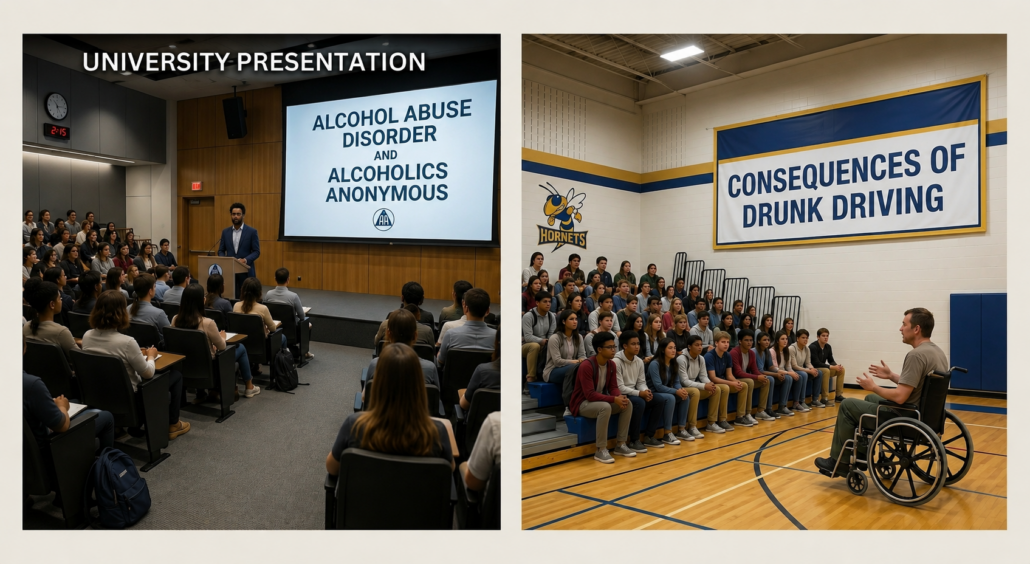
- School visits and informational talks
- Participation in health fairs at schools, churches, and community facilities
- Literature tables at the Ontario Regional Conference (ORC) and other A.A. events
- Educational seminars for University of Toronto medical and nursing students
- Ensuring local media have accurate information about A.A. through P.S.A.’s, anonymity-protected interviews and press kits that uphold our 11th Tradition.
These efforts help increase public awareness of A.A. and how it may be of help to those affected by alcoholism.
Volunteers Needed
We are always looking for A.A. members who are willing to share information about Alcoholics Anonymous with non-A.A. groups.
Committee Members: The first qualification for doing PI, or any other
service work, is sound sobriety. All committee members need to be
thoroughly familiar with the A.A. program and able to provide consistent and accurate information about the Fellowship. Experience in public relations is not essential.
An understanding of the Twelve Traditions, including a firm grasp of
the Anonymity Traditions, is most important. This is often enhanced
through committees studying basic PI material together. Many local PI
committees find it beneficial to review the PI Workbook at their initial
meeting, familiarizing themselves with it before setting goals.
If you are interested in volunteering, you can complete a volunteer form available through:
- The Intergroup office
- Or by by filling out the form at the bottom of this page
About the Committee
The Public Information Committee meets on the third Monday of each month at 7:30 PM at:
234 Eglinton Ave. E., Toronto
During these meetings, District Chairs report on ongoing PI activities, outreach efforts, and upcoming events across the GTA.
We also review and respond to requests received from:
- The press
- Radio and film media
- Educational institutions and community organizations
- Members of the general public
All requests are considered carefully, and occasionally we may decline participation if a request is not consistent with A.A.’s Traditions.
Tradition Eleven
“Our public relations policy is based on attrac-
tion rather than promotion; we need always
maintain personal anonymity at the level of
press, radio, and films.”
ANONYMITY ONLINE AND DIGITAL MEDIA
In all A.A.’s public relations, A.A.’s sole objective is to help the still suffering alcoholic; always mindful of the importance of personal anonymity at the public level.
Public information takes many forms, from the simple sign outside a meeting place, to distribution of A.A. literature, A.A. websites, anonymity protected P.S.A.’s, informational videos, radio, television and digital media. A thoughtful and informed group conscience is encouraged to be responsible for deciding how best to inform members and the public about A.A. and how as members we can
use digital media, practice anonymity and avoid anonymity breaks. Remembering A.A. has no spokesperson.
Below is sharing from A.A. resources as a reminder of the importance of A.A.’s Tradition of Anonymity in our digital lives. In 2013 the General Service Conference affirmed “ . . . that the Internet, social media and all forms of public communications are implicit in the last phrase of the Short Form of Tradition Eleven, which reads: ‘ . . . at the level of press, radio and films.’”
General Principles
- “When appearing on radio, television, film or on the Internet as A.A. members, we refrain from showing our faces or revealing our last names. In printed articles, on websites or email, we are identified by our first names and last initials only.”
*The A.A. Group – Where it All Begins, p. 8 - “When using digital media, A.A. members are responsible for their own anonymity and that of
others. When we post, text, or blog, we should assume that we are publishing at the public level.
When we break our anonymity in these forums, we may inadvertently break the anonymity of
others.”
*Understanding Anonymity, p. 5 - A.A. Websites
“We observe all of A.A.’s principles and Traditions on our websites. As anonymity is the “spiritual
foundation of all our Traditions,” we practice anonymity on A.A. websites. Some A.A. websites
contain password-protected sections for members only, but publicly accessible pages of an A.A.
website have the potential for reaching the broadest possible audience and, therefore, require the
same safeguards that we use at the level of press, radio and film. For more sharing on this topic,
see the resource page Anonymity — A Vital Spiritual Principle on G.S.O.’s website.”
*Frequently Asked Questions about A.A. Websites, p.2
2 - Social Networking Websites
“. . . social networking websites are public in nature. Though users create accounts and utilize
usernames and passwords, once on the site, it is a public medium where A.A. members and non-A.A.s mingle…’
‘…As long as individuals do not identify themselves as A.A. members, there is no conflict of interest. However, someone using their full name and/or a likeness, such as a full-face photograph, would be contrary to the spirit of the Eleventh Tradition, which states in the Long Form that, ‘ . . .
our [last] names and pictures as A.A. members ought not be broadcast, filmed or publicly printed…’ ‘…Even “closed” or “private” groups might still reveal an individual’s identity. Being well-informed prior to joining or starting such a group is the key to protecting your own anonymity,
and that of others.’
*A.A. Guidelines – Internet, p.1,2 - Email
“When using email it is necessary to consider the anonymity of the recipients of messages. Sending messages to multiple recipients that disclose the email addresses of everyone on the addressee list is a potential break of someone else’s anonymity. Therefore, it is a good idea to obtain a
recipient’s explicit permission before using his or her e-mail address for A.A. correspondence, especially if it is a workplace email address. When sending A.A. mail to multiple recipients who wish to remain anonymous, use can be made of the BCC (Blind Courtesy Copy) option available
on most computers.”
*A.A. Guidelines – Internet, p. 4 - Internet
“Many technological options are possible and, presumably, more are being developed each day. Yet . . . it is important not to let the speed of technological development pressure a committee [or an A.A. group] into a quick solution as opposed to a well-thought-out A.A.-oriented decision. Of
course, all decisions must include careful consideration of any situations where an A.A. member’s anonymity could be compromised at the public level.”
*A.A. Guidelines – Internet, p. 5 - Videos and Audios
Sound and visual media help to carry the message of recovery of Alcoholics Anonymous and to inform the public and professionals about A.A. Public Service Announcements (PSAs) are available in both video and audio formats (for television and radio broadcast), as well as other
materials specifically for young people and for professionals working with alcoholics. (check out *Videos and Audios, aa.org) - More Reflections on Anonymity
“Anonymity has two attributes essential to our individual and collective survival; the spiritual and the practical. On the spiritual level, anonymity demands the greatest discipline of which we are capable; on the practical level anonymity has brought protection for the newcomer, respect and
support of the world outside, and security from those of us who would use A.A. for sick and selfish purposes.” - *Bill’s Last Message:
- At this level, according to Bill W., “. . . anonymity—100 percent anonymity—was the only possible answer. Here, principles would have to come before personalities, without exception.”
*Twelve Steps and Twelve Traditions, p. 187 - “. . . anonymity is real humility at work. It is an all-pervading spiritual quality which today keynotes A.A. life everywhere. Moved by the spirit of anonymity, we try to give up our natural desires for personal distinction as A.A. members both among fellow alcoholics and before the general public.
As we lay aside these very human aspirations, we believe that each of us takes part in the weaving of a protective mantle which covers our whole Society and under which we may grow and work in unity.”
*Twelve Steps and Twelve Traditions, p. 187 - “A vast communications net now covers the earth, even to its remotest reaches. Granting all its huge public benefits, this limitless world forum is nevertheless a hunting ground for all those who
would seek money, acclaim and power at the expense of society in general… “Therefore nothing can matter more to the future welfare of AA than the manner in which we use this colossus of communication. Used unselfishly and well, the results can surpass our present
imagination. Should we handle this great instrument badly, we shall be shattered by the ego demands of our own people‒often with the best of intention on their part. Against all this, the sacrificial spirit of AA’s anonymity at the top public level is literally our shield and our buckler. Here again we must be confident that love of AA, and of God, will always carry the day.”
“Freedom Under God: The Choice Is Ours”
Bill W., AA Grapevine, November 1960
(www.aagrapevine.org) - “In my belief, the entire future of our fellowship hangs upon this vital principle. If we continue to be filled with the spirit and practice of anonymity, no shoal or reef can wreck us. If we forget this
principle, the lid to Pandora’s box will be off and the spirits of Money, Power, and Prestige will be loosed among us. . . I am positive that A.A.’s anonymity is the key to long-time survival.”
*A.A. Comes of Age, pp. 131-132
Carrying the A.A. Message
For information on ways to carry the A.A. message while practising A.A.’s Tradition of Anonymity be sure to reach out to our PI committee at publicinformation@aatoronto.org andpi.liaison@aatoronto.org
- At this level, according to Bill W., “. . . anonymity—100 percent anonymity—was the only possible answer. Here, principles would have to come before personalities, without exception.”