



AA Toronto Accessiblesign language at an AA meetingAA Toronto Accessibility

Accessibilities Committee

Accessibility Committees explore, develop, and offer resources to alcoholics with significant barriers to receiving the Alcoholics Anonymous message and to participating in our program of recovery. We want the hand of A.A. to be available to all alcoholics who reach out for it.

This is the primary purpose of the Accessibility Committee.

Star Star

Committee Activities

  • Coordinate Accessibilities workshops at the group, district or area level.
  • Conduct a survey of meetings that are accessible to people in wheelchairs and add this information to local meeting lists (wheelchair accessibility includes both the entrance to the meeting, ramps, elevators and access to bathroom facilities).
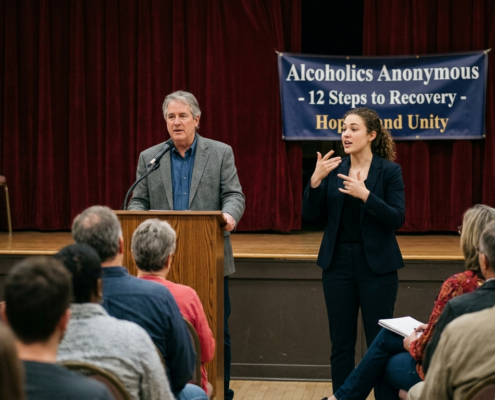
  • Conduct a survey of local, district or area meetings with American Sign Language (A.S.L.) interpretation and add this information to local meeting lists.
  • Help arrange for American Sign Language interpreters at A.A. meetings.
  • Arrange meetings for A.A. members who do not have regular access to A.A. meetings, e.g. in hospitals; rehabilitation centers for those with injuries or physical differences; residences for those with intellectual or information processing challenges; and those in assisted living or skilled nursing facilities.
  • Take a meeting to homebound A.A. members along with two or more members of the Fellowship.
  • Teach homebound members how to access online meeting options.
  • Provide Accessibilities workshops and assistance to people with disabilities at conventions, conferences, service weekends, service meetings, special events, etc.
  • Gather local information and identify outside local resources regarding accessibility requirements and options.
  • Projects that support members with a variety of accessibility challenges
  • Communications that keep the public and appropriate agencies informed about A.A. accessibility
  • Providing resources and guidance to groups so that they can accommodate all A.A. members
  • Plan Special Events
  • Help locate material for blind, deaf and hard of hearing alcoholics with the assistance of Intergroup’s Librarian
  • Provide information to home groups on – Disability Do’s and Dont’s
Star Star

They talk the talk, but do they walk the walk?

We have heard and used the phrase “They talk the talk; but do they walk the walk?”

Please keep this phrase in mind when you consider the following request from the Accessibility Committee of Greater Toronto.

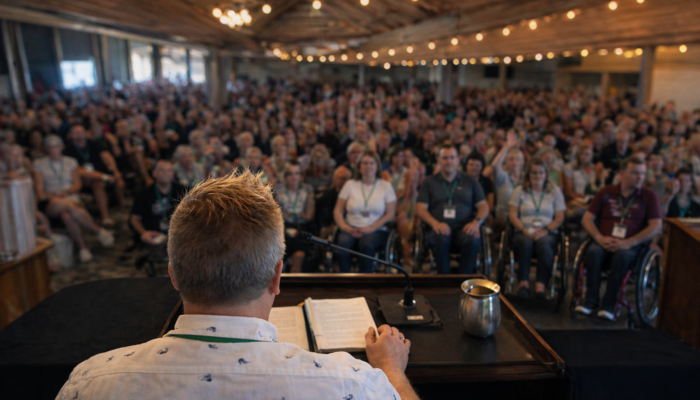
When planning Special Events at your home group or special “Days” (such as Information AA Day, Service Days, and others) please consider making every effort to be fully accessible. “Fully accessible” means people using wheel chairs can take advantage of every aspect of the day; speaker meeting, washrooms, panel discussions, information tables. A truly all inclusive event.

One other note for local planners in the GTA: TTC’s WheelTrans will not come to a location unless given the full address (the name of the building and nearest intersection are not enough). Please provide the complete street name and number.

Star Star

Disability Do’s and Don’ts…

Do respect the needs of a disabled person regarding communication, transportation, etc. Without the provision for these needs, you make the situation worse. Taking a shortcut “just this once” means the problems for persons with disabilities in the workforce continue.

Don’t be afraid to ask. Most persons with disability have lived with them for a long time, and know how to solve the problem, if you ask. Don’t assume. Ask.

Do try to look beyond the disability to the person. Every human being has something to contribute, and many of the world’s greatest contributors have, or had, a disability (Beethoven, Stephen Hawking, John Milton, etc.).

Don’t be afraid to learn. For example, many people are nervous using a TTY to communicate with a person who has a hearing loss. It is a very simple machine to learn (children use it!). Have an adventure, learn something new!

Do, at least, think about taking a risk on a person with a disability. In Canada, over 50% of the disabled are unemployed or underemployed, compared to about 10% national average.

Don’t assume it’s always someone else. Over 90% of disabilities occur after birth. Ultimately, you may be helping yourself.

Accessibility Is Action

Star Star

I am Responsible

When anyone, anywhere reaches out for help, I want the hand of AA always to be there, and for that, I am Responsible

The committee has a variety of ways you can be involved. Please click on the links below

Request for visit:

If you are an AA member, or wish to be one, and you are chronically ill or homebound, if you would like to talk to an AA member by phone, e-mail, or in person, and/or if you would like some things about AA mailed to you, please click above.

  • Willing to volunteer:
    If you are an AA member and you are willing to phone, e-mail, and visit the homebound and/or chronically ill, and/or you are willing to send e-mail in the case of the deaf and hard of hearing, please click here.
  • Wheel Chair Access :
    If you’re a group secretary, let intergroup know about your meeting space and its Accessibility by using the above link.
  • ASL Interpreters Allowed :
    If you’re a group secretary, let Intergroup know if sign-language interpreters are welcome at your open and/or closed meetings by using the link above. Please note that the interpreter may not be an alcoholic, but they adhere to a strict code of ethics regarding confidentiality. They are simply there to facilitate for the deaf alcoholic.
  • Click here to see the interpreters’ code of ethics for more information.
Star Star

Special Material

Material for deaf and hard of hearing alcoholics is available from the Literature Department at:

GTA Intergroup Offices

 234 Eglinton Avenue, Suite 202

Toronto, Ontario M4P 1K5

or by calling 416-487-9865 (TTY number is 416-487-5062)

or by fax at 416-487-5855.

This material includes:

Videotapes

  • (VS-1) Alcoholics Anonymous (Big Book) in American Sign Lanugage (ASL) 5 volume set 1/2″ VHS cassettes
  • (VS-8) Young People and A.A. In this 28-minute film, four young A.A. members describe what it was. 4 like drinking, what happened to bring them to A.A. and what their lives are like sober today. In keeping with A.A. tradition, the identity of the A.A. members is protected. (Closed-captioned English 1/2″-VHS cassette.)
  • (VS-16) Hope: Alcoholics Anonymous explains the principles of A.A.: What A.A. is and isn’t, primary purpose, sponsorship, home group, the Steps and Traditions and basic recovery tools. (Closed-captioned English 1/2″-VHS cassette.)
  • (VS-13) A.A. Rap With Us features four anonymous young A.A. members. Rap music and lyrics bridge these four young people’s stories of alcoholic despair and A.A. recovery. (Closed-captioned English 1/2″-VHS cassette.)
what is AA

Illustrated Pamphlets

  • (P-55) “The Twelve Steps Illustrated
  • (P-38) “What Happened to Joe …”
  • (P-43) “The Twelve Traditions Illustrated”
  • (P-39) “It Happened to Alice!”
  • (P-36) “Is A.A. For Me?”
  • (P-33) “It Sure Beats Sitting in a Cell”
  • (P-37) “Too Young?”

Complimentary A.A. Service Material

  • List of Central Offices, Intergroups, and Answering Services in the U.S. and Canada. (Some have TTY or TDD equipment – for times and locations of local meetings.)
  • Literature: The Twelve Steps for signing purposes
  • The Twelve Traditions for signing purposes
  • The Twelve Traditions (Long Form) for signing purposes
  • .”A Deaf Newcomer Asks …” for signing purposes
  • “How It Works” for signing purposes
  • “Is A.A. For You?” for signing purposes
  • “A Brief Guide to Alcoholics Anonymous”
  • The Serenity Prayer for signing purposes

A.A. Guidelines:

  • “Carrying the A.A. Message to the Deaf Alcoholic”
  • “Serving Alcoholics with Special Needs”

For more information, email us!