Alcoholics Anonymous is a fellowship of people who come together to solve their drinking problem. It doesn’t cost anything to attend A.A. meetings. There are no age or education requirements to participate. Membership is open to anyone who wants to do something about their drinking problem.
A.A.’s primary purpose is to help alcoholics to achieve sobriety.
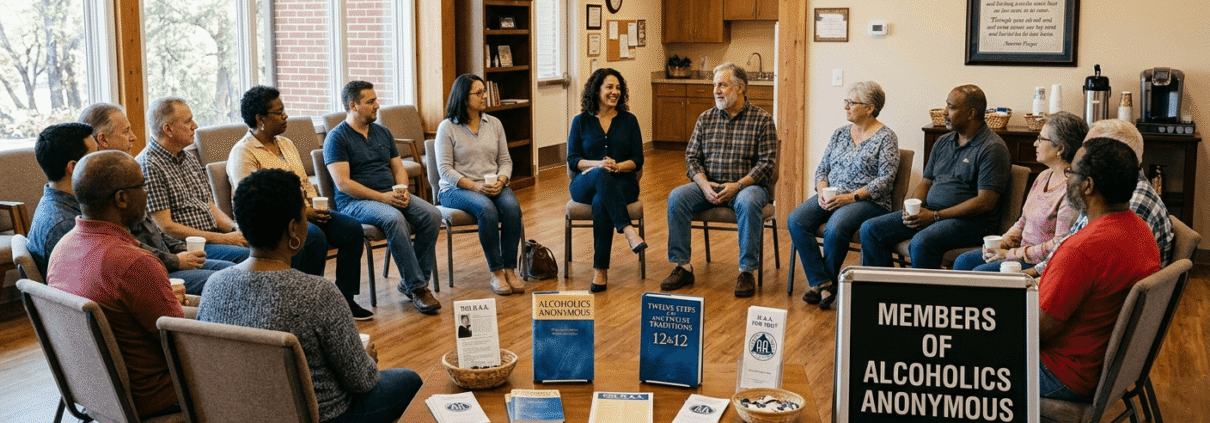
Who are A.A. members?
Alcoholics Anonymous is a fellowship of people who come together to solve their drinking problem. It doesn’t cost anything to attend A.A. meetings. There are no age or education requirements to participate. Membership is open to anyone who wants to do something about their drinking problem.
A.A.’s primary purpose is to help alcoholics to achieve sobriety.
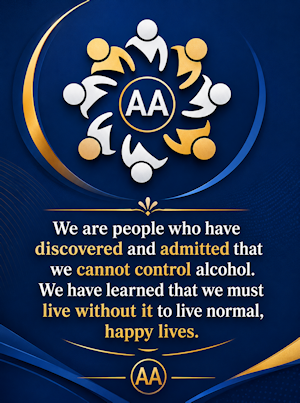
We are NOT anti-alcohol…it’s just not for us.
We have been where you are…and found a solution.
How A.A. Toronto Intergroup operates and helps the A.A. community in the GTA
About Us
GTA Intergroup is the body of Alcoholics Anonymous in The Greater Toronto Area that serves as a forum for discussion and a focus for cooperation and coordination among AA groups in the GTA in carrying the message of Alcoholics Anonymous to the suffering alcoholic.
Prior to GTA Intergroup, individual groups were responsible for Twelve-Step work in hospitals, jails and facilities, and providing information to the public.
There was no local means for members to obtain information, or for the suffering alcoholic to reach out for help. GTA Intergroup helps coordinate work in facilities, provides organized collection and distribution of information, and allows the suffering alcoholic access to the help they want and desperately need through its telephone help line, and more.
Mission
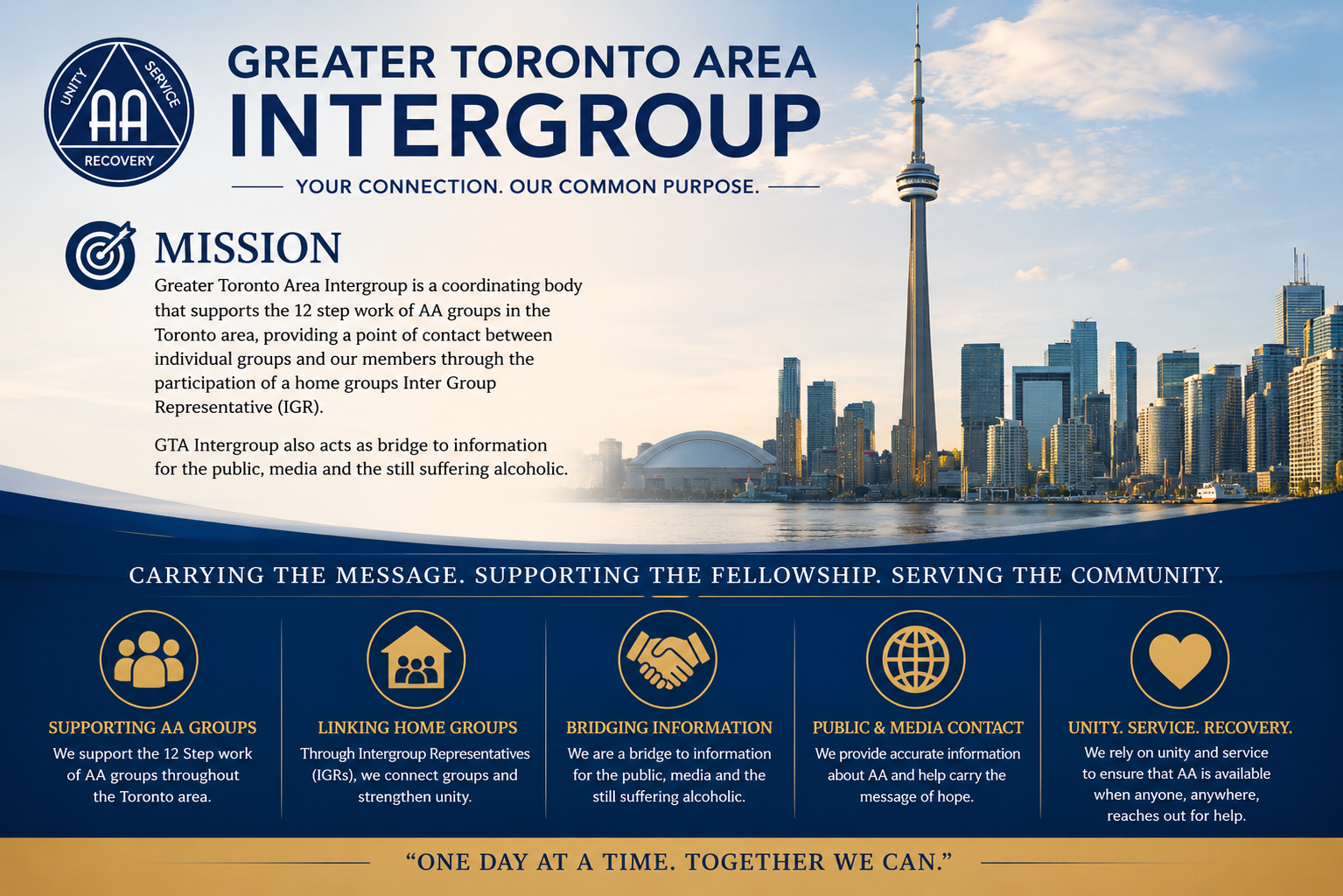
Greater Toronto Area Intergroup is a coordinating body that supports the 12 step work of AA groups in the Toronto area, providing a point of contact between individual groups and our members through the participation of a home groups Inter Group Representative (IGR). GTA Intergroup also acts as bridge to information for the public, media and the still suffering alcoholic.
What we do
- Providing live telephone response for those wondering if they have a drinking problem as well as information for members on meetings, literature and events, seven days a week.
- Providing meeting facilities for Sub-Committees that do service in the community (such as bringing meetings to jails, treatment centers, communications with professionals and the media), and monthly Intergroup meetings for the groups in the GTA.
- Maintaining and utilizing an active list of volunteers for Twelve-Step work.
- Maintaining, publishing and distributing up-to-date meeting information, both in print and online.
- Maintaining the central office, including rent, utilities, office equipment, management and administration staff.
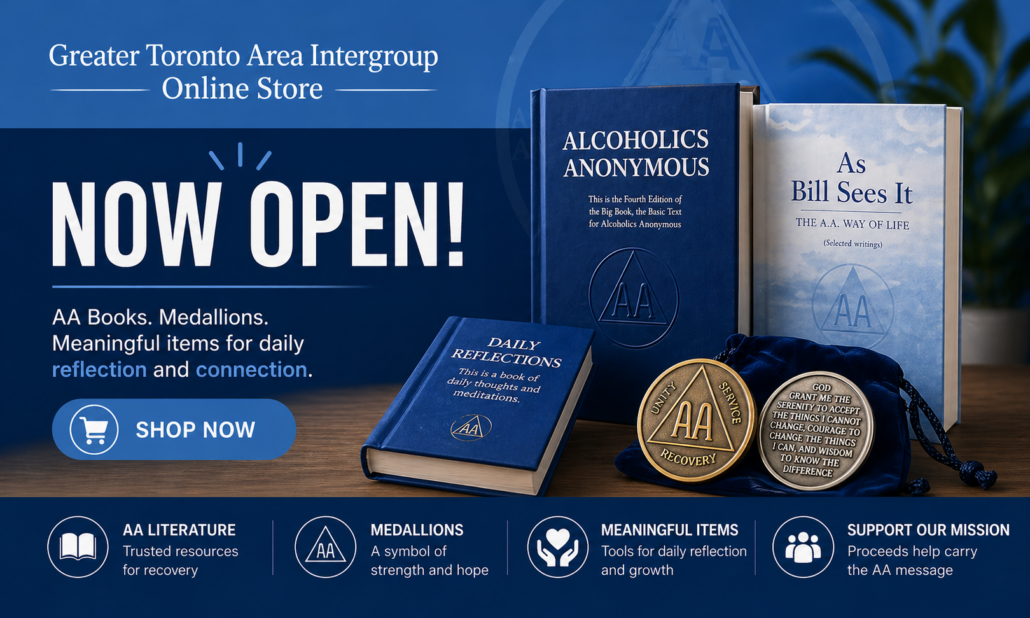
- Distribution of Conference-Approved Literature and medallion and chips for meetings across the GTA.
- Creating, publishing and distributing a monthly newsletter (the Better Times) on recovery in the GTA and abroad.
Where we spend
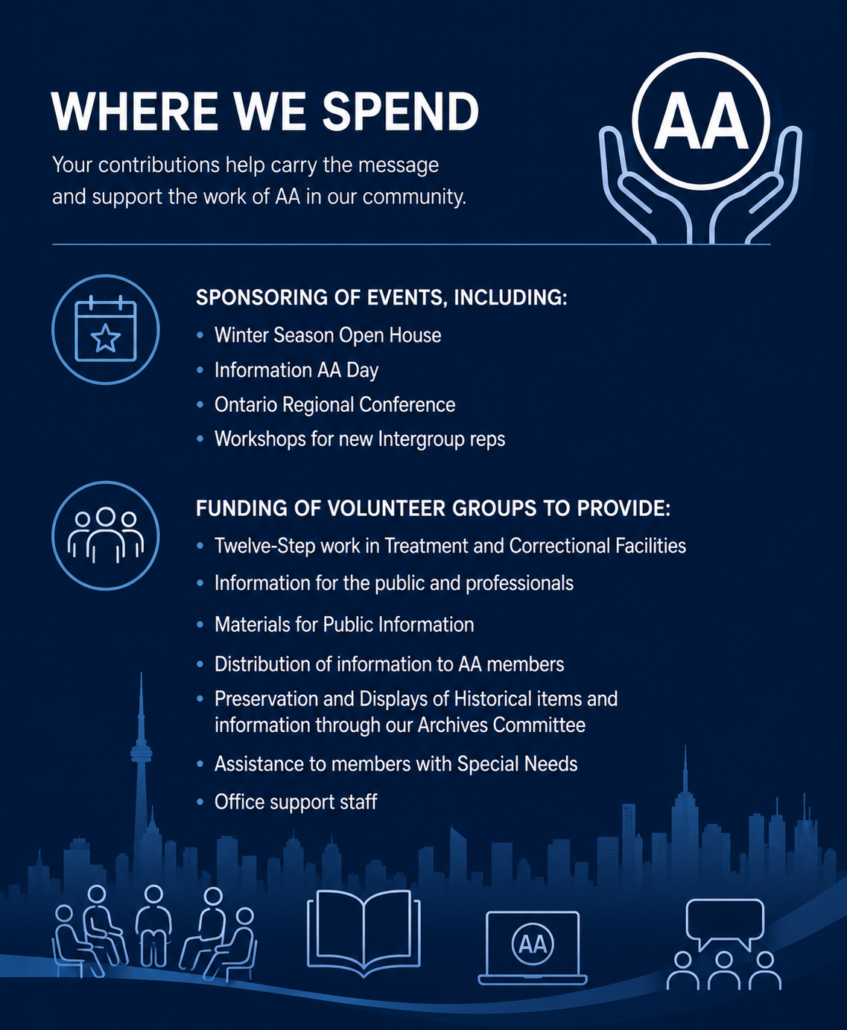
- Sponsoring of events, including:
- Winter Season Open House
- Information AA Day
- Ontario Regional Conference
- Workshops for new Intergroup reps
- Funding of volunteer groups to provide:
- Twelve-Step work in Treatment and Correctional Facilities
- Information for the public and professionals
- Materials for Public Information
- Distribution of information to AA members
- Preservation and Displays of Historical items and information through our Archives Committee
- Assistance to members with Special Needs
- Office support staff
Self Support – the Importance of our 7th Tradition
An excerpt from our 2026 Class B (Alcoholic) Trustee and an Alcoholics Anonymous World Service Director.
” … if you have received this letter, you are already well informed about self support in A.A. My hope is that you will share this letter with some of your A.A. friends who may not be.
One old-timer told me “You are a member now, no one can take that away from you even if you drink, now act like a member, help clean up at every meeting you attend and put something in the basket no matter what.” I wasn’t staying sober, I didn’t have much money, and I was holding onto the little bit of money I did have for things I thought were more important. I was avoiding the basket by going to the washroom when it was passed.
After noticing this, the old-timer started giving me a little spare change from his pocket “for the basket.” He told me, “A.A. is our home, it is up to us to take care of it.” I was deeply ashamed for taking his money (he had none to spare), especially when I knew I had my own spare change. Because of his example, I started putting in what I could. We never discussed how much, or exactly how it was spent, he kept it simple “we do what we can so A.A. is here when we need it.”
I was blessed to join a home group that lived our Twelve Traditions. … At the business meeting we always heard about the services provided and
funds needed by the levels of service (intergroup, district, area, General Service Board).
I once suggested we spend for something we didn’t strictly need and was promptly reminded that “it’s not our money, it passes through the group on its way to support A.A. service entities and carry the message.”
…..
We have so much work yet to do. For example, we have materials in American Sign Language for deaf and hard of hearing members, but these are limited and there are ongoing requests for more items, including the A.A. Service Manual, which might foster more participation. There is a seemingly limitless need for translations, but there are not limitless funds. Then there are our operational needs. Bill spoke often and passionately about our “headquarters” and the need to support the core functioning of the office. There are no services without the operations and that means we have to pay the staff and routine bills that every service organization our size has to deal with.
Early on Bill W. noted “It was soon apparent that while alcoholics would spend lavishly on Twelfth Step cases, they had a terrific aversion to dropping money into a meeting-place hat for group purposes” (from Twelve Steps and Twelve Traditions, chapter on Tradition Seven). This remains just as true today as when it was written. It can be harder to see the direct impact of our contributions to the GSB on the alcoholic who still suffers and because of the scale of the services for an estimated 1.5 million members in the US and Canada. In 1951 Bill W. said “Our present array of services may look like big business to some. But when we think of the size and reach of A.A. today, that isn’t true at all, In 1945,
for example we had one paid worker to every 98 groups (from A.A. Service Manual, Appendix A “A.A.’s Legacy of Service”). Based on our estimated number of groups in the US and Canada, it is now approximately one paid worker to every 748 groups. There is a staggering amount of services provided. You can learn more about that here SMF-176 Services Provided by GSO/AAWS.
At the time I came to A.A. I had given nothing and I received, literally, everything. I received this through the sacrifice of others. In time, I became self-supporting and was no longer a drain on A.A., or anyone else. But it took a little more time before I became a grateful contributor. Even this was still transactional; I was paying my share informed by the financial reports. Finally, there was a shift, and it became about the joy of giving and the spirit of sacrifice instead of what I can easily spare. I have seen countless examples that the sacrifices we each make have a profound and lasting impact on the lives of
alcoholics (and beyond). I am inspired by the possibility of our service entities having more than the minimum funds required for them to survive. I believe that given the resources to do so, these entities can do more to carry our lifesaving message than I can even imagine. The amount of our contribution is secondary to the spiritual connection that joins us together in unity. As it is in A.A., the more I give the more I receive, and so the circle of sacrifice goes on (and on).
I will continue to try to inform newer members, the way others informed me. Simple things are important, like how at my homegroup we announce that “books are available at cost and pamphlets and Grapevines are available through your group contributions,” because nothing is free, someone made a sacrifice to put it on the table. I will continue to share what you taught me, that our Seventh Tradition is not a transaction, it is a sacrifice made in a spirit of gratitude, trust, and faith.
With gratitude love and service,
Carolyn W. ”